Four women journalists were stripped naked in public in Kenema, Eastern Sierra Leone where they were covering events to mark the International Day against female circumcision (genital mutilation).They were snatched by members of a secret society, forcibly stripped and made to parade naked through the streets on February 9, 2009. They were only freed after the intervention of the police and human rights organizations. They were accused by their aggressors of reporting against female circumcision which is considered an insult to their culture.
Tuesday, March 31, 2009


Friday, March 27, 2009
South African women fall victim to 'corrective rape'
The partially clothed body of Eudy Simelane, former star of South Africa's acclaimed Banyana Banyana national female football squad, was found in a creek in a park in Kwa Thema, on the outskirts of Johannesburg. Simelane had been gang-raped and brutally beaten before being stabbed 25 times in the face, chest and legs. As well as being one of South Africa's best-known female footballers, Simelane was a voracious equality rights campaigner and one of the first women to live openly as a lesbian in Kwa Thema.

Eudy Simelane (Right)
Her brutal murder took place last April, and since then a tide of violence against lesbians in South Africa has continued to rise. Human rights campaigners say it is characterised by what they call "corrective rape" committed by men behind the guise of trying to "cure" lesbians of their sexual orientation.
Wednesday, March 25, 2009
First All-Female U.N. Peacekeeping Force in Liberia

Indian female soldiers of Rapid Action Force ahead of departure to Liberia as U.N. peacekeepers.(photo:AP/Fox News)
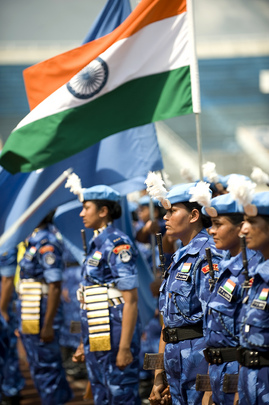
Members of the all female Indian Formed Police Unit of the United Nations Mission in Liberia (UNMIL) get ready to receive medals of honour, in recognition for their service. (UN Photo/Christopher Herwig)

Members of the all female Indian Formed Police Unit of the United Nations Mission in Liberia (UNMIL) perform martial arts exercise prior to receiving medals of honour, in recognition for their service. (UN Photo/Christopher Herwig)

Members of the all female Indian Formed Police Unit (FPU) of the United Nations Mission in Liberia (UNMIL) stand ready to receive medals, in recognition for their service. (UN Photo/Christopher Herwig)
Tuesday, March 24, 2009
A forgotten story : Slavery in Romania
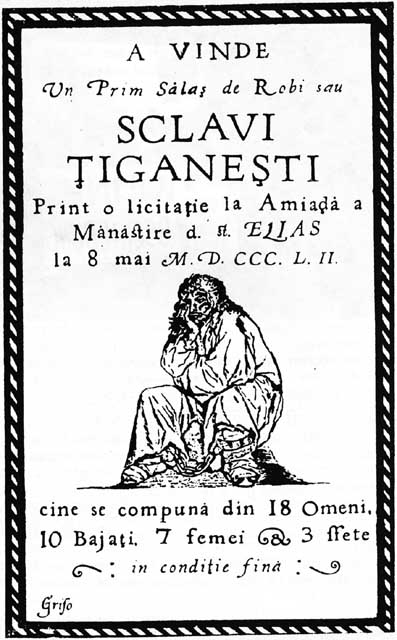
An 1852 poster advertising an auction of Roma slaves in Bucharest, Romania.
Slavery of Roma people (Gypsies) existed on the territory of present-day Romania from before the founding of the principalities of Wallachia and Moldavia in 13th–14th century, until it was abolished in stages during the 1840s and 1850s.
The slaves were considered personal property of the master. They were objects of exchange, sometimes sold by weight; a Rom could be sold for a smaller price than two copper pots, a Roma child could be bought for a smaller price than a cow, because she was not yet good capable of working full-time. Masters offered Roma girls as pleasure toys to their guests; they had the right of life and death over the slave.
The master was allowed to punish his slaves physically, through beatings or imprisonment. 1821, at a time when Boyars in Moldavia fled their country to escape the Eterist expedition, Austrian authorities in Bukovina were alarmed to note that the newly-settled refugees made a habit of beating their slaves in public, and consequently issued an order specifically banning such practices. A dispute followed, after which the Boyars received permission to carry on with the beatings, as long as they exercised them on private property.
The master was allowed to punish his slaves physically, through beatings or imprisonment. 1821, at a time when Boyars in Moldavia fled their country to escape the Eterist expedition, Austrian authorities in Bukovina were alarmed to note that the newly-settled refugees made a habit of beating their slaves in public, and consequently issued an order specifically banning such practices. A dispute followed, after which the Boyars received permission to carry on with the beatings, as long as they exercised them on private property.

A Shatra or Roma(Gypsy) slave village, Romania, 1850s.
In a gradual, step-by-step process, Roma began to lose their cultural identity and internalise their inferior status in society. Ashamed of themselves, perceiving their ethnic identity as damnation, they were stigmatised and excluded from the society of their former masters. Roma thus became a scapegoat for all the frustrations and failures of Romanian society.
Sunday, March 22, 2009
Sterile Dreams: Forced Sterilization of Romani women in Slovakia and Czech Republic
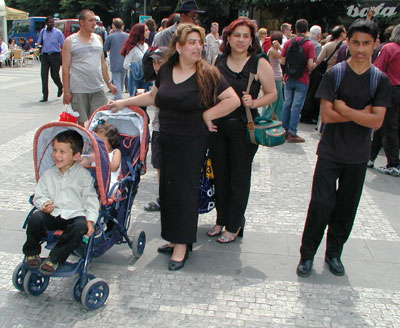
Romani women are being coerced or forced to undergo sterilization procedures in Slovakia’s government-run health facilities, according to a new report released today by the Center for Reproductive Rights and Poradna pre obcianske a ludské práva, in collaboration with Ina Zoon. Two hundred and thirty in-depth interviews were held with Romani women in 40 settlements in eastern Slovakia. The investigative report documents grave human rights violations against Romani women in Slovakia, including about 110 cases where women were forcibly or coercively sterilized, or had strong indications that they had been sterilized. The report also documents extensive racism and verbal and physical abuse towards Romani women in public hospitals, including the denial of patient access to their own medical records and segregation in patients’ rooms, maternity wards, restrooms and dining facilities.

Agata, 28, from Svinia,Slovakia talks about being Coercively Sterilized: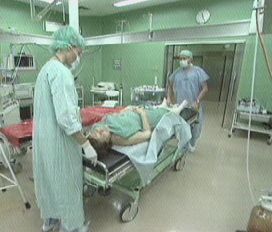
"Doctors came and brought me to the operating room [for a C-section] and there they gave me anesthesia. When I was falling asleep, a nurse came and took my hand in hers and with it she signed something. I do not know what it was. I could not check because I cannot read, I only know how to sign my name. When I left the hospital, I was only told that I would not have any more children…I was so healthy before, but now I have pain all the time. Lots of infections…"
Alexandra from Richnava,Slovakia talks about Racial Segregation in Slovakia’s Public Hospitals:
"In Krompachy hospital, there are separate rooms for Roma—there are three Gypsy rooms, one shower and one toilet for us while white women have their own toilets. White women can go to the dining room but Roma cannot eat there. In Gypsy room, there is not even a dust bin. It is like in a concentration camp there."
Romani women in Slovakia continue to be subject to grave violations of their human rights, particularly their reproductive rights, even though a communist-era law offering monetary incentives for sterilization has been rescinded. A three-month fact-finding in late 2002 by the Center for Reproductive Rights and Poradna pre obcianske a ludské práva (Centre for Civil and Human Rights), a Slovak human rights organization, reveals that not only do coerced and forced sterilization practices continue in Slovakia, so too does the widespread abuse and discrimination against Romani women in the country’s maternal health services. We conducted extensive interviews with more than 230 women in almost 40 Romani settlements throughout eastern Slovakia, the region with the highest concentration of Roma.
The interviews revealed numerous instances of coerced, forced and suspected sterilization of Romani women, along with physical and verbal abuse, racially discriminatory standards of care, misinformation in health matters, and denial of access to medical records.

Iveta Cervenakova, was forcibly sterilized after the birth of her second daughter 12 years ago. She was among possibly as many as a quarter of a million Roma (Gypsy) women sterilized against their will in the Czech Republic.Since the end of the cold war and the opening up of central and eastern European countries in 1990, the living conditions of the Roma and Sinti minority have drastically deteriorated as a result of nascent racism. However, racist-motivated violence and discrimination against Roma and Sinti have significantly increased in a large number of countries in western Europe. As The New York Times correctly observed in a commentary in March 1996, members of the minority are today subjected to marginalization and racism to an extent that corresponds to the situation of African-Americans in the United States up until the mid-1950s.
A notable cause for the continued marginalization and discrimination of Roma and Sinti is the structures of prejudice and racist clichés, which have been substantially influenced by the misanthropic racial ideology of the National Socialists and the associated fascist regime. In view of these ideological lines of continuity, it is hardly surprising that Roma and Sinti minorities are not only socially disadvantaged to a considerable extent but are also repeatedly the victims of open violence. The authorities in eastern and western Europe have recorded a drastic increase in racist violence against minorities by neo-Nazis; however, such attacks increasingly emanate from the security forces themselves. Only rarely can the perpetrators expect consistent prosecution and conviction by the police and legal authorities. As an example, the police officers responsible for the obviously racist-motivated murders of two Bulgarian Roma in 1996 were not punished by competent authorities; only after a judgement of the European Court of Human Rights in 2005 was the Bulgarian State obliged to investigate the racist background to this crime. The Court issued a similar adjudication in a comparable case, also in Romania; in all probability, however, the perpetrators will escape criminal prosecution appropriate to a State governed by the rule of law.
Thursday, March 19, 2009
Racism still alive in the "Rainbow Nation": White students force black cleaners to drink urine soup

The alleged victims vomited after being made to eat fouled food
Watch Video
Several white students in South Africa face criminal charges after allegedly forcing black campus employees to eat food that had been urinated on. A video has surfaced last year (Feb 2008) which appears to show the students forcing elderly workers to eat dirty meat and drink soup into which they had urinated.
A violent backlash against the film caused all classes to be suspended yesterday as hundreds of staff and students marched in protest. Police fired stun grenades to disperse an angry crowd gathered outside the whites-only halls of residence where the film was shot. A narrative in Afrikaans indicates the video was recorded in protest at a new university integration policy to integrate black and white students in the same residences at the University of the Free State, Bloemfontein.In the video the white students, who make no attempt to hide their faces, order the black cleaners at the whites-only Reitz hostel to down full bottles of beer. They then lead them to a playing field where they are told to display their athletic skills. In the final extract a white man urinates on food and into a plastic soup container. Then, shouting: Take! Take! in Afrikaans he apparently forces the campus employees to eat the dirty food, causing them to vomit.
Wednesday, March 18, 2009
Iranian students unveil book mocking Holocaust victims

An Iranian woman looks at a new book mocking the Holocaust in Tehran on September 26, 2008. Photo: AFP
A group of Islamist students unveiled the book today in an annual parade marking Al-Quds (Jerusalem) Day to show solidarity with the Palestinians. Featuring dozens of cartoons and sarcastic commentary, the book "Holocaust" was published by student members of the Basij militia. The book comes two years after an Iranian newspaper commissioned a competition of Holocaust-themed cartoons.
The book's cover depicted a Jew with a hooked nose dressed in traditional clothes drawing the outlines of dead bodies on the ground.Inside pages have pictures of bearded Jews shown leaving and re-entering a gas chamber with a counter that reads 5,999,999.Another picture shows a hospital patient covered in an Israeli flag and on life support, breathing Zyklon-B, the poisonous gas used in the death camps.

The book's cover depicted a Jew with a hooked nose dressed in traditional clothes drawing the outlines of dead bodies on the ground.Inside pages have pictures of bearded Jews shown leaving and re-entering a gas chamber with a counter that reads 5,999,999.Another picture shows a hospital patient covered in an Israeli flag and on life support, breathing Zyklon-B, the poisonous gas used in the death camps.

A patient covered in an Israeli flag and on life support breathing Zyklon-B, the poisonous gas used in the extermination chambers.
The commentary inside the book includes anti-Semitic stereotypes and revisionist arguments, casting doubt on the massacre of Jews and mocking Holocaust survivors who claimed reparations after World War II.
One comment in a question-and-answer format reads:
"How did the Germans emit gas into chambers while there were no holes on the ceiling?" Answer: "Shut up, you criminal anti-Semite. How dare you ask this question?"
Sunday, March 15, 2009
Beaten into silence : Battered women in Africa
Africa's highest-ranking female politician has spoken out about the beatings which she said were responsible for her separation from her husband. Specioza Kazibwe, Uganda's former Vice-President, serving from 1994 until 2003, being the first woman in Africa to hold that position said that she had been forced to throw her engineer husband out of their house - which she had built - when she decided enough was enough. Her comments have caused a stir in a society where the subject is largely taboo."Why should I continue staying with a man who beats me?" she was quoted by the New Vision newspaper as telling women legislators. However, the the reaction to Mrs Kazimbwe's action had been varied in Uganda. Mrs Kazibwe should have kept it in the family, said one woman, Diana. "I come from north of the country, where women are told to respect their husbands even if they are abused or beaten up," Diana added."I am happy with the tradition because men are more superior to us and I think, without men, we would not be what we are now."

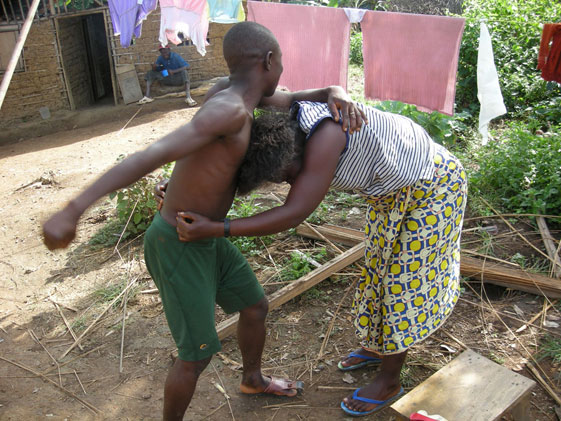
Men feel free to assault women in public, with complete impunity. A Global Crescendo photographer caught this man beating his pregnant wife. The man in the background looking on appears to be laughing.
Wife beating has traditionally been swept under the social carpet. Few women, including those who are financially independent, have dared to come out and say that they're being battered. It has always happened, everywhere. Often it is accepted as a natural if regrettable part of woman's status as her husband's property. Throughout history women have been subjected to the whims and brutality of their husbands.
Women suffer from violence in every society. In few places, however, is the abuse more entrenched, and accepted, than in sub-Saharan Africa. One in three Nigerian women reported having been physically abused by a male partner, according to the latest study, conducted in 1993. The wife of the deputy governor of a northern Nigerian province told reporters last year that her husband beat her incessantly, in part because she watched television movies.

It is like it is a normal thing for women to be treated by their husbands as punching bags," told Obong Rita Akpan, former Nigerian minister for women's affairs, here. "The Nigerian man thinks that a woman is his inferior. Right from childhood, right from infancy, the boy is preferred to the girl. Even when they marry out of love, they still think the woman is below them and they do whatever they want."
Women suffer from violence in every society. In few places, however, is the abuse more entrenched, and accepted, than in sub-Saharan Africa. One in three Nigerian women reported having been physically abused by a male partner, according to the latest study, conducted in 1993. The wife of the deputy governor of a northern Nigerian province told reporters last year that her husband beat her incessantly, in part because she watched television movies.

It is like it is a normal thing for women to be treated by their husbands as punching bags," told Obong Rita Akpan, former Nigerian minister for women's affairs, here. "The Nigerian man thinks that a woman is his inferior. Right from childhood, right from infancy, the boy is preferred to the girl. Even when they marry out of love, they still think the woman is below them and they do whatever they want."
In Zambia, nearly half of women surveyed said a male partner had beaten them, according to a 2004 study financed by the United States - the highest percentage of nine developing nations surveyed on three continents. About 80% of Zambian wives find it acceptable to be beaten by their husbands "as a form of chastisement", according to the Zambia Demographic Health Survey.

A World Health Organization study has found that while more than a third of Namibian women reported enduring physical or sexual abuse by a male partner, often resulting in injury, six in seven victims had either kept it to themselves or confided only in a friend or relative.
In South Africa, researchers for the Medical Research Council estimated last year that a male partner kills a girlfriend or spouse every six hours - the highest mortality rate from domestic violence ever reported, they say. In Harare, Zimbabwe's capital, domestic violence accounts for more than 6 in 10 murder cases in court, a United Nations report concluded last year.
Women's rights activists say that the prevalence of abuse is emblematic of the low status of women in sub-Saharan Africa. Typically less educated, they work longer hours and transport three times as much weight as men, hauling firewood, water and sacks of corn on their heads.
Some societies have the idea that women are foolish and childlike, and need to be beaten to be corrected. In one survey, 44.7 percent of Kenyan women said that men have the right to discipline their wives by beating. The women who are beaten often feel that it is their fault. Even many matrilineal and matrilocal societies accept men beating their wives as correction.
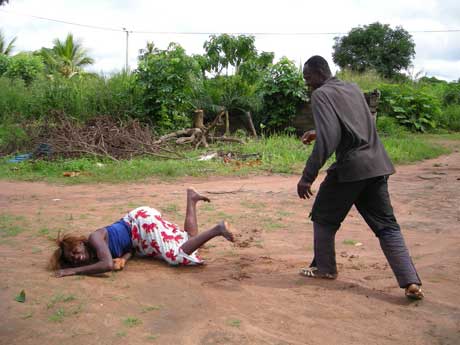
In some Sub-Saharan African countries where wife beating is widely accepted as a response to women's transgressing gender norms, women are More likely than men to justify wife beating. An analysis of Demographic and Health Survey data from in seven Sub-Saharan African countries found that 36-89% of women justified wife beating in at least one of five specified situations such as if she burns the food, neglects the children, argues with him, goes out without telling him or refuses to have sex with. The analysts contend that women's acceptance of wife beating "may be explained only by entrenched social and cultural learning processes that subjugate the position of women in the society, socially and collectively undermine their self-esteem and facilitate romanticisation of the 'ideal' gender role of women."
1946 Lynching Re-enacted in Georgia, USA

Rosie Crowley, center, portrayed the pregnant Dorothy Malcom Monday in a re-enactment of a group lynching in Monroe, Georgia., on July 25, 1946. No one was ever prosecuted for the four killings.The lynchings of Roger and Dorothy Malcom, and George and Mae Murray Dorsey on July 25, 1946, have long been a source of racial tension in Monroe, a town about 45 miles east of Atlanta.
See and hear scenes from the re-enactment
On July 25, 1946, two black couples were riding in a car with a white farmer when they were ambushed by a group of about 20 armed men, believed to be Ku Klux Klan members. The four (Roger and Dorothy Malcom and George and Mae Murray Dorsey) were dragged from the car, beaten savagely and shot over 60 times while they pleaded for their lives. All four died, as well as Dorothy Malcolm's unborn child. The lynching was gruesome and the fact that George Dorsey had been a distinguished soldier in WWII infuriated the public. No one was ever charged in the lynchings, even though the FBI’s report named 55 suspects.
On July 25, 2005, fifty-nine years to the day after the incident a group reenacted the murders, with the hope that the federal government would reopen the case and bring those that were involved to justice.
On July 25, 2005, fifty-nine years to the day after the incident a group reenacted the murders, with the hope that the federal government would reopen the case and bring those that were involved to justice.
Cold-case Convictions in USA
1977: Ex-Klansman Robert Chambliss convicted of 1963 church bombing that killed four black girls in Birmingham, Alabama
1994: Byron de la Beckwith convicted in 1963 sniper murder of Mississippi civil rights activist Medgar Evers
1998: Former Klan leader Samuel Bowers convicted in the death of NAACP leader Vernon Dahmer Sr., killed in 1966 firebombing of his Mississippi home
2001, 2002: Thomas Blanton Jr. then Bobby Frank Cherry convicted of involvement in 1963 Birmingham church bombing
2003: Earnest Avants convicted in 1966 slaying of handyman Ben Chester White, purportedly to lure the Rev. Dr. Martin Luther King Jr. to Natchez, Mississippi
2005: Edgar Ray Killen sentenced to 60 years in prison for the 1964 "Mississippi Burning" manslaughter of three civil rights workers in Philadelphia, Mississippi
2007: Former sheriff's deputy and Klansman James Ford Seale convicted in the 1964 deaths of two Mississippi teenagers
-- Sources: CNN, The Associated Press
Saturday, March 14, 2009
Cat woman of Nigeria !!!

Aisha Ibrahim was involved in an auto-accident in Port Harcourt, Nigeria.,but case particularly attracted the media attention because an unusual occurrence was attributed to her. Eyewitnesses said she was hit by a car as a cat, but later transformed into a woman.As the story goes three cats were crossing the busy road when an okada (motorcycle taxi) ran over. One of them immediately turned into a woman. This strange occurrence quickly attracted people around who descended on the scene. A crowd soon gathered, accused her of being a witch and began to beat her up using whatever he came with or could lay his hands on right there. Finally, policemen arrived a the spot and fenced her away from the attackers wanted her dead.
However,another witness gave a completely different account of the incident. He said “I saw the accident as it happened, I saw the car hitting a woman. I didn’t see any cat and it was surprising when everybody said she was a cat and started beating her up instead of helping her.”
Subscribe to:
Posts (Atom)


 Posts
Posts

