Showing posts with label Women. Show all posts

Wednesday, March 25, 2009

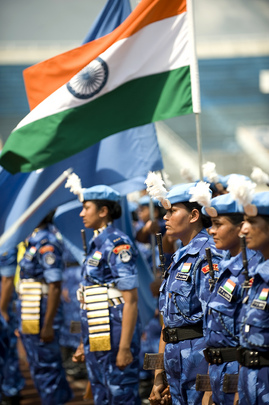
First All-Female U.N. Peacekeeping Force in Liberia

Members of the all female Indian Formed Police Unit of the United Nations Mission in Liberia (UNMIL) get ready to receive medals of honour, in recognition for their service. (UN Photo/Christopher Herwig)


Members of the all female Indian Formed Police Unit of the United Nations Mission in Liberia (UNMIL) perform martial arts exercise prior to receiving medals of honour, in recognition for their service. (UN Photo/Christopher Herwig)


Members of the all female Indian Formed Police Unit (FPU) of the United Nations Mission in Liberia (UNMIL) stand ready to receive medals, in recognition for their service. (UN Photo/Christopher Herwig)

Sunday, March 22, 2009

Sterile Dreams: Forced Sterilization of Romani women in Slovakia and Czech Republic


Romani women are being coerced or forced to undergo sterilization procedures in Slovakia’s government-run health facilities, according to a new report released today by the Center for Reproductive Rights and Poradna pre obcianske a ludské práva, in collaboration with Ina Zoon. Two hundred and thirty in-depth interviews were held with Romani women in 40 settlements in eastern Slovakia. The investigative report documents grave human rights violations against Romani women in Slovakia, including about 110 cases where women were forcibly or coercively sterilized, or had strong indications that they had been sterilized. The report also documents extensive racism and verbal and physical abuse towards Romani women in public hospitals, including the denial of patient access to their own medical records and segregation in patients’ rooms, maternity wards, restrooms and dining facilities.


Agata, 28, from Svinia,Slovakia talks about being Coercively Sterilized:
"Doctors came and brought me to the operating room [for a C-section] and there they gave me anesthesia. When I was falling asleep, a nurse came and took my hand in hers and with it she signed something. I do not know what it was. I could not check because I cannot read, I only know how to sign my name. When I left the hospital, I was only told that I would not have any more children…I was so healthy before, but now I have pain all the time. Lots of infections…"

Alexandra from Richnava,Slovakia talks about Racial Segregation in Slovakia’s Public Hospitals:
"In Krompachy hospital, there are separate rooms for Roma—there are three Gypsy rooms, one shower and one toilet for us while white women have their own toilets. White women can go to the dining room but Roma cannot eat there. In Gypsy room, there is not even a dust bin. It is like in a concentration camp there."

Romani women in Slovakia continue to be subject to grave violations of their human rights, particularly their reproductive rights, even though a communist-era law offering monetary incentives for sterilization has been rescinded. A three-month fact-finding in late 2002 by the Center for Reproductive Rights and Poradna pre obcianske a ludské práva (Centre for Civil and Human Rights), a Slovak human rights organization, reveals that not only do coerced and forced sterilization practices continue in Slovakia, so too does the widespread abuse and discrimination against Romani women in the country’s maternal health services. We conducted extensive interviews with more than 230 women in almost 40 Romani settlements throughout eastern Slovakia, the region with the highest concentration of Roma.
The interviews revealed numerous instances of coerced, forced and suspected sterilization of Romani women, along with physical and verbal abuse, racially discriminatory standards of care, misinformation in health matters, and denial of access to medical records.


Iveta Cervenakova, was forcibly sterilized after the birth of her second daughter 12 years ago. She was among possibly as many as a quarter of a million Roma (Gypsy) women sterilized against their will in the Czech Republic.
Since the end of the cold war and the opening up of central and eastern European countries in 1990, the living conditions of the Roma and Sinti minority have drastically deteriorated as a result of nascent racism. However, racist-motivated violence and discrimination against Roma and Sinti have significantly increased in a large number of countries in western Europe. As The New York Times correctly observed in a commentary in March 1996, members of the minority are today subjected to marginalization and racism to an extent that corresponds to the situation of African-Americans in the United States up until the mid-1950s.

A notable cause for the continued marginalization and discrimination of Roma and Sinti is the structures of prejudice and racist clichés, which have been substantially influenced by the misanthropic racial ideology of the National Socialists and the associated fascist regime. In view of these ideological lines of continuity, it is hardly surprising that Roma and Sinti minorities are not only socially disadvantaged to a considerable extent but are also repeatedly the victims of open violence. The authorities in eastern and western Europe have recorded a drastic increase in racist violence against minorities by neo-Nazis; however, such attacks increasingly emanate from the security forces themselves. Only rarely can the perpetrators expect consistent prosecution and conviction by the police and legal authorities. As an example, the police officers responsible for the obviously racist-motivated murders of two Bulgarian Roma in 1996 were not punished by competent authorities; only after a judgement of the European Court of Human Rights in 2005 was the Bulgarian State obliged to investigate the racist background to this crime. The Court issued a similar adjudication in a comparable case, also in Romania; in all probability, however, the perpetrators will escape criminal prosecution appropriate to a State governed by the rule of law.

Sunday, March 15, 2009

Beaten into silence : Battered women in Africa

Africa's highest-ranking female politician has spoken out about the beatings which she said were responsible for her separation from her husband. Specioza Kazibwe, Uganda's former Vice-President, serving from 1994 until 2003, being the first woman in Africa to hold that position said that she had been forced to throw her engineer husband out of their house - which she had built - when she decided enough was enough. Her comments have caused a stir in a society where the subject is largely taboo."Why should I continue staying with a man who beats me?" she was quoted by the New Vision newspaper as telling women legislators. However, the the reaction to Mrs Kazimbwe's action had been varied in Uganda. Mrs Kazibwe should have kept it in the family, said one woman, Diana. "I come from north of the country, where women are told to respect their husbands even if they are abused or beaten up," Diana added."I am happy with the tradition because men are more superior to us and I think, without men, we would not be what we are now."
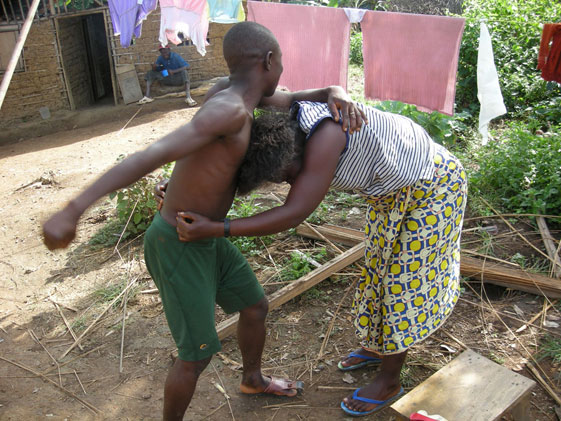
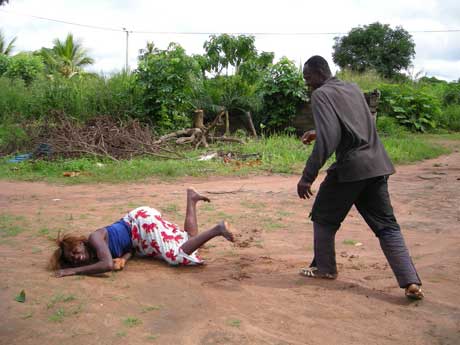
Men feel free to assault women in public, with complete impunity. A Global Crescendo photographer caught this man beating his pregnant wife. The man in the background looking on appears to be laughing.

Wife beating has traditionally been swept under the social carpet. Few women, including those who are financially independent, have dared to come out and say that they're being battered. It has always happened, everywhere. Often it is accepted as a natural if regrettable part of woman's status as her husband's property. Throughout history women have been subjected to the whims and brutality of their husbands.

Women suffer from violence in every society. In few places, however, is the abuse more entrenched, and accepted, than in sub-Saharan Africa. One in three Nigerian women reported having been physically abused by a male partner, according to the latest study, conducted in 1993. The wife of the deputy governor of a northern Nigerian province told reporters last year that her husband beat her incessantly, in part because she watched television movies.


It is like it is a normal thing for women to be treated by their husbands as punching bags," told Obong Rita Akpan, former Nigerian minister for women's affairs, here. "The Nigerian man thinks that a woman is his inferior. Right from childhood, right from infancy, the boy is preferred to the girl. Even when they marry out of love, they still think the woman is below them and they do whatever they want."

In Zambia, nearly half of women surveyed said a male partner had beaten them, according to a 2004 study financed by the United States - the highest percentage of nine developing nations surveyed on three continents. About 80% of Zambian wives find it acceptable to be beaten by their husbands "as a form of chastisement", according to the Zambia Demographic Health Survey.

A World Health Organization study has found that while more than a third of Namibian women reported enduring physical or sexual abuse by a male partner, often resulting in injury, six in seven victims had either kept it to themselves or confided only in a friend or relative.


In South Africa, researchers for the Medical Research Council estimated last year that a male partner kills a girlfriend or spouse every six hours - the highest mortality rate from domestic violence ever reported, they say. In Harare, Zimbabwe's capital, domestic violence accounts for more than 6 in 10 murder cases in court, a United Nations report concluded last year.


Women's rights activists say that the prevalence of abuse is emblematic of the low status of women in sub-Saharan Africa. Typically less educated, they work longer hours and transport three times as much weight as men, hauling firewood, water and sacks of corn on their heads.


Some societies have the idea that women are foolish and childlike, and need to be beaten to be corrected. In one survey, 44.7 percent of Kenyan women said that men have the right to discipline their wives by beating. The women who are beaten often feel that it is their fault. Even many matrilineal and matrilocal societies accept men beating their wives as correction.

In some Sub-Saharan African countries where wife beating is widely accepted as a response to women's transgressing gender norms, women are More likely than men to justify wife beating. An analysis of Demographic and Health Survey data from in seven Sub-Saharan African countries found that 36-89% of women justified wife beating in at least one of five specified situations such as if she burns the food, neglects the children, argues with him, goes out without telling him or refuses to have sex with. The analysts contend that women's acceptance of wife beating "may be explained only by entrenched social and cultural learning processes that subjugate the position of women in the society, socially and collectively undermine their self-esteem and facilitate romanticisation of the 'ideal' gender role of women."

Saturday, March 14, 2009

Pakistani lawmaker defends burying women alive

Five Pakistani women were beaten, shot and buried alive in the tribal region of Baluchistan on July 13 of this year. What was more shocking was the subsequent defence of these ‘honour’ killings from certain members of the Pakistan Senate.

Women's groups have expressed outrage over the killings

Israr Ullah Zehri, who represents province where the women died, told a stunned parliament that tribesmen had done nothing wrong in first shooting the women and then dumping them in a ditch."These are centuries-old traditions, and I will continue to defend them,.Only those who indulge in immoral acts should be afraid." he said.

The women, three of whom were teenagers, were first shot and then thrown into a ditchin what was a brutal episode of honour killing.They were still breathing as mud was shoveled over their bodies, according to media reports, which said their only "crime" was that they wished to marry men of their own choice, against the wishes of tribal elders.

According to details, the women were about to leave for the civil court so that the three girls could marry the men of their choice. Their decision to get married in court was the result of several days of discussions with the elders of the tribe who refused them permission to marry. As the news of their plans leaked out, a group of men abducted them at gun point. and taken in a vehicle to another remote area,. After reaching there, the men took the three younger women out of the jeep and beat them before allegedly opening fire on them. The girls were seriously injured but were miraculously still alive at that moment. They were hurled into a wide ditch and later covered with earth and stones. The two older women - an aunt of one of these girls and the other, the mother of one minor - when protested and tried to stop the burial of the girls who were still alive-further enraged the attackers. They were so angry at the interference that they pushed the elderly women in the ditch along with the injured girls and buried them alive too. After completing the burial, they fired several shots in the air so that no one would come close.

It is considered an insult in some conservative regions of Pakistan for women to have affairs or marry without consent, and rights groups say hundreds are killed by male relatives every year.Reaction of Dr Farzana Bari, a university professor and a human rights activist from Islamabad who is leading the outcry against these crimes:

Desire to control women’s lives and their sexuality is far greater in areas where feudal and tribal systems are prevalent. For example, you will not find the same oppression of women in Islamabad, Karachi or Lahore. But where there is a strong tribal or feudal hold you see that women’s sexuality is strictly controlled by the family – and particularly the male members of the family.

Monday, March 9, 2009

Public Caning in Aceh and Sharia Tourism


An Acehnese woman kneels to be caned by Sharia law authorities Jan.12, 2007 in Banda Aceh, Indonesia.


Tourism authorities in Indonesia's Aceh province hope that this practice of Sharia or Islamic law will attract visitors. "We invite international tourists to visit Aceh to observe how an Islamic community lives and how the Islamic code of Sharia is applied," said Cipta Hunai, an Aceh tourism official, in an interview with Adnkronos International (AKI).

He said that Sharia law in Aceh was a tourist attraction because it allowed foreigners to see a reality, that perhaps, they did not already know. "Here the tourists can visit many mosques and see how a community lives under laws based on the Koran," he said. "


Muslim-devout Aceh is the only province in Indonesia allowed to apply Sharia law. However observers say that the application of Sharia in the province has harmed the rights of the poor and women.The Indonesian government agreed to allow Shariah law in Aceh four years ago as part of negotiations to end the 29-year war between separatist rebels and the military.

Canning is carried out in Aceh for crimes including the sale or consumption of alcohol, gambling or meeting a person of the opposite sex, that is not your husband, wife or family member, in a private place.


Sunday, March 8, 2009

Female Suicide Bombers

What motivates a woman to carry out a deadly strike?
Many of the women are determined to avenge the deaths of loved ones. Islam Online featured an interview with Um Mustafa, a woman who was training to become a suicide bomber. After her husband and two children were killed in the U.S. offensive in Fallujah in 2004, Mustafa approached members of al-Qaida in Iraq and stated, "I will give my life to God wherever my leader tells me to do so."

However women may also turn to violence as a result of feeling depressed, or lacking a sense of purpose after the loss or detention of a family member. And terror experts also point out that as al-Qaida's network weakens in Iraq, it has turned to recruiting more women to keep its cause alive.


Saturday, March 7, 2009

Mandaean woman in Iraq

(Photo by AFP/Getty Images)
A Mandaean woman is seen as they attend a ritual on the banks of the Tigris River in Baghdad on September 21 2008. Baptism is the central sacrament of Mandaean religious life, revering several Old Testament characters especially John the Baptist. Since the invasion of Iraq by the US-led forces the 100,000-strong sect has depleted to 5000, with most fleeing the country. The Mandaeans have practiced their Gnostic religion for generations along the banks of the Tigris after they were driven out of Jordan and settled in southern and central Iraq around AD 67.

A short story of a woman

A Rwandan Tutsi woman Jeanne's story as written for the Women and War Project:
…On 18th May, four heavily armed soldiers knocked at the gate and took me back to my deserted home. They asked me, 'Is this your house? Do you love it? Now choose the best room where we can shoot you from.' I knew my day had come because they looked like hungry lions. Filled with anger, one of them opened the wardrobe and ordered me to enter and be killed.

Another opened a big envelope and found our marriage photo. He saw my husband Dr. Guillaume, and remembered him. 'Where is he?' he asked 'We separated when fleeing,' I answered. He dropped his gun. 'We must have killed many useful people who had been good Samaritans to us,' he regretted.

Then he showed us one of his legs that had been operated on. 'I was involved in a fatal accident and the doctors had decided to have my leg amputated but Dr. Guillaume objected,' said the soldier. 'Dr. Guillaume said, 'We shall amputate him if all efforts prove a failure. He is still young.'

'Now!' said the soldier, 'You are the only Tutsi who still survives in this area. Find where to escape to because you won't survive the next group.' I hadn't wept since the genocide, but this time I did because that's when I saw someone having mercy on me.


Rwanda - Since gaining its independence in 1961, Rwanda's major tribes, the Hutu's and the Tutsi's, have battled for control of the country. These struggles climaxed in April 1994, when the controlling Hutu army, the Intrahame (official death squads) and even some Hutu citizens, began killing Tutsi's and some moderate Hutu's in one of the worst genocides of the 20th century. In six months, nearly one million people died before the Tutsi army regained control of the country in October 1994.

Friday, March 6, 2009

Mauritania: Fat women are beautiful, Thin women are disgusting !!!


Obesity is so revered among Mauritania's white Moor Arab population that the young girls are sometimes force-fed to obtain a weight the government has described as "life-threatening".Now only around one in 10 girls are treated this way. The treatment has its roots in fat being seen as a sign of wealth - if a girl was thin she was considered poor, and would not be respected.

Mint was 4 when her family began to force her to drink 14 gallons of camel’s milk a day. When she vomited, she was beaten. If she refused to drink, her fingers were bent back until they touched her hand. Her stomach hurt so much she prayed all the animals in the world would die so that there would be no more milk.By the time Mint was 10, she could no longer run. Unconcerned, her proud mother delighted in measuring the loops of fat hanging under her daughter’s arms.“My mother thinks she made me beautiful. But she made me sick,” says Mint, who suffers from weight-related illnesses including diabetes and heart disease.

To end the brutal feeding practices, the government has launched a TV and radio campaign highlighting the health risks of obesity. Because most Mauritanian love songs describe the ideal woman as fat, the health ministry commissioned catchy odes to thin women.These efforts, combined with the rising popularity of foreign soap operas featuring model-thin women, has helped reduce the practice, especially among the country’s urban elite.

Although few women are force-fed today, many feel pressured to be bigger-than-average. Many have turned to a more scientific method of weight gain, using foreign-made appetite-inducing pills.


Kurdish Women Fighters


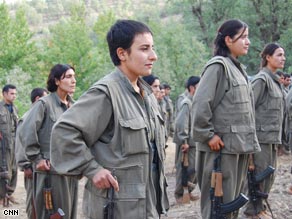
Kurdish women fighters on the Iraq Turkish border

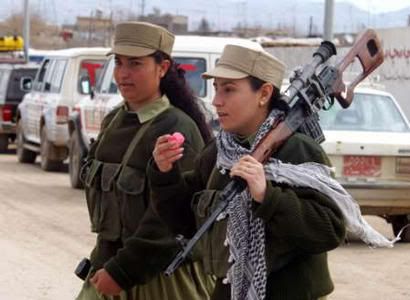
Iraqi Kurd women fighters cross a street in the front of Chamchamal's military headquarters near the frontline with Saddam Hussein's troops on March 21, 2003.


"We want a natural life, a society that revolves around women, where women and men are equal, a society without pressure, without inequality, where all differences between people are eliminated," says Rengin, the head of a female battalion of the Kurdistan Workers' Party, or PKK.


PEJAK Kurdish woman fighter, (PEJAK - Party for a Free Life in Kurdistan), PEJAK fights against the Iran regime for self-rule in the country's mainly Kurdistan province northwestern of Iran

A Kurdish woman fighter has said in the 30's that "a lion is a lion, neither male nor female."
Click here for a Film about Kurdish Women Freedom Fighters


Afghan Police Women


Thursday, March 5, 2009

Pakistani Police Women


Iranian Police Women